Showing posts with label Earth Age. Show all posts

Thursday, December 27, 2012

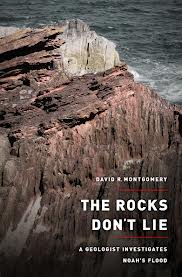
The Rocks don’t lie


A review of The Rocks Don’t Lie: A Geologist Investigates Noah’s Flood, by David R. Montgomery
Creationists are notorious for distorting or denying the facts of biology (evolution), paleontology (denying the evidence of evolution in fossils), physics and astronomy (denying modern cosmology), and many other fields. But some of their most egregious attempts to twist reality to fit their bizarre views are found in “flood geology,” a concoction of strange ideas about the geologic record that clearly demonstrate how little actual experience any of them has in looking at real rocks. I dissected this issue in great detail in Chapter 3 of my 2007 book, Evolution: What the Fossils Say and Why it Matters (Columbia University Press, New York).
David Montgomery, however, devotes an entire book to the topic of geology and creationism. The title is tantalizing, making one wonder whether this is yet another creationist book disguised as real science. But the content is relatively straightforward. Montgomery is a well-respected geomorphologist at the University of Washington who has studied landforms around the world, and he makes it clear up front that he is not about to support the ridiculous ideas of flood geology. Instead, he embarks on a long narration that is part travelogue, part history, and part description of the breakthroughs in biblical scholarship that long ago led to the rejection of biblical literalism by anyone who can actually read the Bible in the original Greek and Hebrew.
His first chapter looks at a number of places on earth where he has done research on Ice Age glacial dams and floods, and shows that they show no evidence of being part of a global flood. In Chapter 2, he recounts the evidence of Grand Canyon with the creationist’s Grand Canyon: A Different View in his hands as he hikes, and remarks (p. 16) simply that “the story was nothing like the tale I read in the rocks I had spent the day hiking past.” Unfortunately, he does not provide enough detail (or illustrations of key outcrops) to really debunk the interpretations of “flood geologists”.
The next two chapters then recount the early history of geology, from the Greeks and Romans, to the Middle Ages when scholars and natural historians tried to shoehorn all of earth history into the narrow accounts of Genesis, and finally were forced to reject the idea of Noah’s Flood by about 1840—all without losing their Christian faith. At the end he remarks (p. 91), “After Cuvier, the drive to find evidence of Noah’s Flood in the rocks was well and truly dead, although modern creationists would later resurrect the idea.” The next chapter then carries the historical narrative through the birth of modern geology, with Hutton, Buckland, and Lyell, and the eventual realization that the earth is immensely old with (in Hutton’s words) “no vestige of a beginning.”
Chapter 8 then jumps to another topic altogether: the discovery by George Smith and the others of ancient Sumerian and Babylonian flood myths that were directly plagiarized by the authors of Genesis. In Chapter 9, Montgomery looks at flood myths in cultures all over the world, and shows that there is no evidence they are describing a single universal flood of Noah. Chapter 10 then goes through the history of modern American creationism, from the Kentucky “Creation Museum” to the birth of fundamentalism, to George Macready Price and his amateurish efforts to create a new “flood geology” in the 1920s through the 1950s. Throughout this account, Montgomery points out how far from reality Price’s imaginary geology was, and how it was fought by genuine Christian geologists like J. Laurence Kulp, who attempted to reconcile Genesis and geology without violating the laws of earth science. Kulp’s efforts were eventually overshadowed by the later backlash into extreme fundamentalism, and marked the end of any attempt at scientific rationality trumping literalism in the creationist community.
Chapter 12 shifts to the story of J Harlen Bretz and the “Scablands floods,” and how this and other Ice Age glacial-dam floods bear no resemblance to Noah’s Flood (despite creationist attempts to hijack this discovery to their advantage). Then in Chapter 13, Montgomery describes the modern incarnation of “flood geology” proposed by Whitcomb and Morris in the 1960s, and this marked the birth of the current creationist attempts to push “flood geology” on the faithful. Throughout the chapter, Montgomery points out the absurdities of the Whitcomb-Morris model. In his final chapter, Montgomery talks about the conflict between science and faith, and tries to be conciliatory to both sides, as long as religion doesn’t try to deny science with absurdly literalistic interpretations of the Bible. In the final pages (pp. 256-257), he adopts a lofty tone:
“The scientific story of the origin and evolution of life, the vast sweep of geologic time, and the complexity of the processes that shaped the world we know today inspire more awe and wonder than the series of one-off miracles from Genesis that I read about in Sunday School. Miracles do not fuel curiosity or innovation. If we embrace the claim that Earth is a few thousand years old, we must also throw out the most basic findings of geology, physics, chemistry or biology. The concept of geologic time, on the other hand, opens up an entirely new creation story, along with the idea that the world is unfinished and creation is ongoing. And a complex, evolving world is one we would be well advised to do our best to understand. Personally, I find a world that invites exploration and learning more inspiring than a world where all is known….Yet no honest search for truth can deny geological discoveries—not when the Earth’s marvelous story is laid out for all to see in the very fabric of our world. We may argue endlessly about how to interpret the Bible, but the rocks don’t lie. They tell it like it was.”
In summary, Montgomery has covered nearly all the bases relevant to creationism, Noah’s ark myths, and “flood geology.” His tone is deliberately relaxed and non-confrontational, and he makes a great effort to educate the reader (both geologist and creationist) about the historical background to these ideas, and why Christian geologists in the 1830s and 1840s rejected Noah’s flood as soon as the rock record became well enough known. He is clearly trying to win the reader who is religious but conflicted about creationism and “flood geology” without saying anything that might alienate either side. My own preference, as I showed in my 2007 evolution book, is to be a bit more pointed and direct, and call a spade a spade when creationists are distorting the truth. I prefer to be explicit in the details of why “flood geology” is wrong, and not to gloss over such evidence (since the creationists themselves seem to relish this sort of nitpicking). I’m not sure which approach works better. Judging from the reviews of Montgomery’s book on its Amazon.com site, most readers seemed to like the gentle tone, although many reviewers would have preferred a stronger attack on creationist absurdities. The one creationist review on Amazon.com shows the usual complete lack of comprehension of the book (if he read any of it at all). If Montgomery attempted to really reach them, his non-confrontational, history-heavy approach did not succeed. However, it cannot hurt to have books with more than one approach to tackling “flood geology” and creationism available on the market. I recommend this book to anyone who wants to read about the background to the debate and the general nature of the evidence, and doesn’t require the point-by-point refutation of creationism that other sources (such as my 2007 book, or the www.talkorigins.org website, provide). Either way, science wins with such books in the hands of readers wavering on the fence between science and superstition.

Wednesday, December 5, 2012

The Top 10 Claims Made by Creationists to Counter Scientific Theories by George Dvorsky

The Top 10 Claims Made by Creationists to Counter Scientific Theories:

One of the most challenging tasks for the modern day creationist to is reconcile the belief in a 6,000 year old Earth with the ever-growing mountain of scientific evidence pointing to a vastly different conclusion — namely a universe that's 13.5 billion years old and an Earth that formed 4.5 billion years ago. So, given these astoundingly dramatic discrepancies, biblical literalists and 'young Earth creationists' have had no choice but to get pretty darned imaginative when brushing science aside. Here are 10 arguments creationists have made to counter scientific theories.

Go To Article

'via Blog this'

Monday, July 9, 2012

11 Eye-Opening Highlights From a Creationist Science Textbook - 11Points.com


A few months ago, I was reading about homeschooling, because I do things like randomly reading about homeschooling. I read an article that mentioned a family using science textbooks produced by Bob Jones University. (If you're not familiar, that's a large, for-profit, evangelical Christian university in South Carolina.) I had to see what one of those textbooks was like. I bought one for a few bucks on Amazon and a few slow shipping weeks later, I had my answer. 

I purchased a copy of Science 4 for Christian Schools, an evangelical-written and -approved science textbook published in 1990. According to the stamp on the inside cover, my copy was previously owned by The Country Church & Country Christian School in Molella, Oregon. So, thanks guys!
Read On

'via Blog this'

Sunday, March 25, 2012

God Said Stars Are Made from Water?--Exposing PseudoAstronomy

God Said Stars Are Made from Water?:
This is a quick post that is kinda another “WTF?” post from something that the young-Earth creationist (YEC) Institute for Creation Research’s (ICR) “science” writer Brian Thomas put out in his article, “What Causes a Galaxy’s Magnetism?“
About the first two-thirds of the article is basically parroting a press release about a new map of the Galaxy’s magnetic field. The jist of the press release is that a team of astronomers has mapped our galaxy’s magnetic field to higher precision and accuracy than had been done previously with an eye towards studying extragalactic magnetic fields: you need to know what’s in the way before you can figure out what’s going on with a far-off object. It can also act, over time, on slightly magnetized dust and gas within the galaxy.
But – gasp! – we don’t know why the Galaxy has a magnetic field to begin with! As the ICR article states, “Secular astronomers are no closer to understanding what could cause galactic magnetic fields than they were when they first detected the fields over a century ago.” (That’s the first sentence of the article.) You kinda know what’s coming next … a God of the Gaps argument.
From what I can tell – and this is WAY outside of my field so if any astronomer who knows more about this reads this post, please post in the Comments – the statement is true that we don’t really know what caused the Galaxy’s magnetic field to form in the first place. But, a very recent article has an idea that it may have formed from a background field “seed” that became stronger as the Galaxy formed. So it’s not like we’re totally ign’ant, there are ideas out there.
But no, apparently that’s not good enough. Creationists have to figure it out from the Bible, and …
“In 2008, physicist D. Russell Humphreys proposed a Bible-centered model for the origin of magnetic fields that is consistent with the overall strength of the spiral Milky Way’s magnetic field. If God formed the stars and galaxies during the fourth day of creation using water that He had created earlier, and if those water molecules were all originally aligned, their tiny magnetic fields would have combined to form a galactic magnetic field that has decayed to something that looks like today’s observed field strength.”
Yup, that’s right. The premise of this creationist proposal is that stars are made from water. I really don’t think anything else needs to be said at this point.

Friday, March 23, 2012

The Faint Young Sun Paradox

Posted 22/03/2012 by eyeonicr in Daily (pseudo)Science Updates. Tagged: ICR, Astronomy, Creationism, Science,Skeptic, Brian Thomas, Skepticism, Global Flood, Faint young sun paradox.
The Faint Young Sun Paradox:
If our Sun is, as we believe, a perfectly normal 4.5 billion-year-old main sequence star, we would expect that, say 3 billion years ago it would be largely the same as another main sequence star of that age. And, 3 billion years ago, we would thus expect that the sun would output around 70% of the energy it does today. Unfortunately, this is too little to sustain liquid water on the surface of the Earth. And yet, we know that there was.
This, then, is the faint young Sun paradox.
The Sun, through a telescope (a bad idea, but somebody managed it...)
As you can probably guess, this has the creationists jumping for joy. Never mind our very ability to predict this kind of thing being a testament to our models of stellar evolution. Hence, the DpSU for Wednesday: Can Solar ‘Belch’ Theory Solve Sun Paradox?


The notion that the earth and cosmos are billions of years old continues to present serious problems for evolutionary scientists. For instance, billions of years ago, the sun would only have glowed faintly, leaving nearby earth totally frozen. But with no liquid water on earth’s surface, how could life have evolved and become fossilized so long ago?
This conundrum has been called the “faint young sun paradox,” and after 25 years of research, it remains just as problematic as ever. Scientists have tinkered with models of what they thought were atmospheres that might have kept earth warm. But sunlight would have prevented an ammonia-caused greenhouse earth, and earth’s oldest rocks show that the atmosphere was not dominated by the mild greenhouse gas carbon dioxide either.
There are, it should be pointed out, other greenhouse gases. And the people who came determined that “earth’s oldest rocks show that the atmosphere was not dominated by the mild greenhouse gas carbon dioxide” – you’ll note that Mr Thomas forgot to add that they are ‘supposedly’ Earth’s oldest rocks – came up with their own solution to the paradox. And their results were disputed – I’m not sure of the outcome.


Since researchers have found no solutions to the faint young sun paradox through planetary geophysics, some now look to reconfigure the sun’s evolutionary history. A team of researchers funded by the NASA astrobiology program plans to test new models of a sun that may have been large enough and that also existed early enough to have heated the earth billions of years ago.
Penn State University’s Steinn Sigurdsson will lead the team using a powerful computer program to model the early sun. He told Astrobiology Magazine that “to provide enough planet warming without overstepping any solar constraints, the Sun had to lose the extra mass in roughly the first few hundred million years.…That implies a solar wind that is about 1,000 times faster than what we currently observe.” Sigurdsson and his team plan to look for “stretch marks” left by such a tremendous break in solar wind.
A testable hypothesis! The link is here.


In order to make the solar physics work out correctly, the team needed to invent a way for the sun to discharge incredible amounts of its own mass within a narrow time range. Otherwise, the question of why the early sun might have been too faint for life on earth would be replaced by the equally vexing question of why today’s sun does not scorch the earth.
Or, possibly, they could try a different mechanism to solve the paradox.


Of course, even if the researchers cobble together ancient events that fit with physics, that does not mean that the events actually happened.
I need to remember this quote next time Flood Geology comes up: it shall be my new “When do the differences enter the conversation?”
I mean seriously, pretty much every model that tries to resolve this paradox has better support than the weird ideas the creationists come up with to explain away the impossibility of their Flood. Indeed, judging by their standards of evidence they would all be correct, which would ironically itself present a paradox.


For example, if a mega solar “belch” could have enabled the early sun to heat up earth enough for ancient life to survive, that would still not solve the problem. It would merely change the question from “How could a young sun not have been so faint?” to “What could have forced a young sun to eject so much material so quickly?”
Hey, science! That’s how it works, Brian: each ‘answer’ raises more and more questions. Scientists have had centuries to come up with a way to keep themselves permanently gainfully employed: you must admit that they pulled it off.


But the biblical model of a young world suffers none of these conundrums. The faint young sun paradox remains unsolved for those who insist on a long-ages cosmology. And its solution, despite upgrades in scientific software, promises to evade the naturalistic view.
The idea that the earth and sun were both created during the creation week thousands of years ago, with the sun immediately able to provide life-supporting light as Genesis records, is perfectly consistent with scientific observations.
Er, no – again, creationists are always making up these borderline-possible (if at all) models with no evidence better than “you can’t say it’s impossible – at least, not in the time it’ll take for me to change the subject.”
So, tu quoque Brian. But there seems to be no good reason why science can’t eventually agree on the correct solution: perhaps, if they were all true to a degree, you wouldn’t need such high levels of greenhouse gasses; the solar wind wouldn’t have to have been as strong etc. But the creationists? Well, if it comes down to it, I need to ask the ICR some day which model of the Flood they support: as it stands B.T. is just jumping between those that suit him at a given moment.

Filed under: Daily (pseudo)Science Updates Tagged: Astronomy, Brian Thomas, Creationism, Faint young sun paradox, Global Flood, ICR, Science, Skeptic, Skepticism

Friday, January 6, 2012

Regardless, The Dead Sea Does by Brian Thomas


Regardless, The Dead Sea Does


It goes without saying that the title for Wednesday’s Daily (pseudo)Science Update is a bit of an exaggeration: Dead Sea Sediment Core Confirms Genesis.
The last time that style of title was used it was for Genetics Analysis of Jews Confirms Genesis, in which we were told that a genetic study showed that Jews had interbred to some degree with sub-Saharan Africans – which of course proves that one of the sons of Jacob married an Egyptian as reported in the bible, that Moses married an Ethiopian, and that Science has Confirmed Genesis.
Panorama of the Dead sea from Mount Sodom
The dead sea is a highly saline body of water located in the Middle East. It’s so saline that it was apparently previously believed that it could not shrink more than 150 metres below its present depth, a maximum of 377 metres.
However, a sediment core turned up, 235 metres down (corresponding to 120,000 years ago, I might add), a layer of pebbles probably corresponding to a time when that part of the lake was the shore, showing that at the time the lake all-but dried up.
How does this confirm Genesis? It’s a bit of a stretch, as you might expect. First, remember that the YECs compress the remaining thousands/millions of years after the sediments deposited by the Flood into the period of roughly 2500 BCE to 1 CE. They believe that the Flood caused an ice age, which produced the features we attribute to the various glaciations of the present ice age, but really fast. For some context, the Dead Sea (or whatever was there at the time) went up with the glaciations, and down with the warmer interglaciations – the drying that caused the pebble layer would have been particularly severe.
According to the Bible, in around 2000 B.C. what is now the Dead Sea used to be a plain that probably served as farmland for people of the nearby debauched city of Sodom. Genesis 14 first named the valley during the time of Abraham (then called Abram) as “the vale of Siddim, which is the salt sea.” So, the area was apparently a vale, or valley, but had been relabeled “the salt sea” by the time the original writings were edited and compiled, probably by Moses some 400 years after Abraham.
Which, aside from anything else, is a nice admittance of the bible not quite being the ‘unchanging word of God.’
Lake LisanThere are a few problems here. For one, around 25 thousand years ago the area was flooded by a ‘Lake Lisan’ to the extent that it filled the whole area all the way up to the Sea of Gallile. It’s a little odd that that was never mentioned in the bible, isn’t it? It would change a lot. For more information on the ‘limnological history’ of the Dead Sea try this pdf, from which I’ve stolen the map at right (you can’t read it? Click the link). Again, you’d think somebody would’ve noticed.
Additionally, the Science NOW article being used as a reference for all this mentions that:
Most of the core is a series of black and white layers of sediment, representing seasonal variations. Dark sediments containing mud and silt from winter floods alternate with summertime sediment rich with white calcium carbonate precipitated from a seasonally shrinking lake. “It’s an absolutely phenomenal record,” Goldstein said. Overprinted on those finely detailed, seasonal layers in the core is a similar but larger-scale variation between wetter ice ages and drier interglacial warm periods. “Salt represents the Dead Sea declining and precipitating out the salt, which wasn’t happening during the ice ages,” Goldstein said.
Woah there! Varves? If they make up ‘most’ of the core, and the core was a full kilometre long, then there is probably a few more than, oh, 6000 of them? If so, how would Mr Thomas explain them?
Finally, for all this talk of “a plain that probably served as farmland for people of the nearby debauched city of Sodom,” the layer of pebbles is on top of a layer of salt, forty metres thick! Could be difficult to farm there…
So, does it ‘confirm Genesis’? No. Frankly, it does a better job of contradicting the YEC story.

Thursday, December 29, 2011

Nice argument for the age of the earth | Pharyngula

Nice argument for the age of the earth | Pharyngula: Nice argument for the age of the earth
December 29, 2011 at 4:39 pm PZ Myers

"Geoffrey Pearce sent me this argument he uses with creationists, and I thought others might find it useful, too.

I am regularly approached by young Earth creationists (yes, even in the bedlam of sin that is Montreal…) both on the street and at home. If I have the time I try to engage them on the age of Earth, since Earth is something whose existence them and I agree upon. They will tell me that Earth is somewhere between 6,000 – 10,000 years old, and, when prompted, that the rest of the universe is the same age as well. I have taken the approach of responding to this assertion by pulling out a print of the far side of the Moon (attached, from apod.nasa.gov)."
Go To Article

Tuesday, October 11, 2011

Reflections from the Other Side: Those Pesky Craters

"Young earth creationists have a pretty serious problem. They're burdened with the task of explaining how all of this happened in just 6,000 years. We see craters like these on most solid bodies in our solar system, but for the sake of simplicity let's focus just on lunar craters for now. "