Response to Jonathan Wells, Part 2
This is a continuation of my response to Jonathan Wells’ review of The Language of God by Francis Collins. His words will be in italics. In this post we’ll look at his attempts to poke holes in evolutionary theory through inconsistent family trees (showing relationships of living things to one another):
Not only can phylogenies constructed with DNA conflict with each other, but they can also conflict with phylogenies based on morphology. Take whales, for example – fossils of which Collins asserts are “consistent with the concept of a tree of life of related organisms.” On morphological grounds, evolutionary biologist Leigh Van Valen proposed in the 1960s that modern whales are descended from an extinct group of hyena-like animals.13
I’ve read Wells’ citation, and it seems that this paper proposes that whales are descended from Mesonychians, a group of carnivores. Note that Mesonychians are artiodactyls, so the discrepancy in this hypothesis and more recent findings is not quite as dramatic as one might think (artiodactyls are still the group which whales belong to).
Then, in the 1990s, molecular comparisons suggested that whales are more closely related to hippopotamuses 14. In 2001, however, evolutionary biologist Kenneth D. Rose reported that “substantial discrepancies remain” between the morphological and molecular evidence 15.
This is true. However, it seems to me that Wells is sensationalizing this a bit. As Ken Rose’s paper demonstrates, there are three major hypotheses to take into consideration: That whales evolved from mesonychians, or that they evolved from artiodactyls (there are two hypotheses here, one being that hippopotami are more closely related to whales and the other being that hippopotami are more closely related to other artiodactyls). This debate seems to me to be a simple argument not over which groups are related, but precisely how closely they are related. It’s simply not worthy of the sensationalism Wells gives it.
Furthermore, he overplays controversies while failing to recognize the overwhelming consistency of phylogenies. For instance, molecular biologists had long been saying that hippopotami were closely related to whales (making whales artiodactyls and not mesonychians) and fossil evidence later confirmed this view, as Rose’s paper shows.
Even more intriguing is that one of the papers he cites says the following:
“‘Every gene I've ever sequenced says the same thing. The molecular data is all fairly consistent,’ says John Gatesy of the University of Wyoming in Laramie, one of the first who reported the whale-hippo connection. Some researchers have taken to calling this the whippo hypothesis.”**
And in 2007, J. G. M. Thewissen and his colleagues pointed out that since whales appear in the fossil record 35 million years before hippopotamuses “it is unlikely that the two groups are closely related.” Thewissen and his colleagues concluded from morphological comparisons that whales are descended from a raccoon-like animal instead. 16
I emailed Dr. Thewissen about this paragraph, and here is how he responded:
“Not a very honest citation of my 2007 work. My paper found that the closest relative to whales is among the even-toed ungulates, and says so explicitly. We did comment on the large gap in the fossil record, but only to make the point that there must be closer, extinct relatives to whales than hippos are. Our analysis shows that that gap is filled by a small even-toed ungulate from India. However, our analysis did not discuss the modern even-toed ungulates very exhaustively (which we state explicitly in that paper). After our paper, that has been done by Theodor and Geisler (in 2009 also in Nature), and they did confirm our results that the Indian fossil even-toed ungulate is the closest relative to whales and further found that hippos, in spite of the absence of very old fossils for them, are the closest living relative, to whales, thus confirming what the molecular scientists had found. As often happens in science, when new evidence is discovered and evaluated, scientists have the opportunity to test hypotheses they had. In this case, new evidence brought the morphological and molecular evidence in line and the discrepancy that existed before is resolved.
“The gap in the hippo fossil record remains. Scientists use the phrase ‘ghost-lineage’ to describe this. There must be a substantial period when hippos were around, but there is no fossil evidence for them, or they cannot be recognized in the fossil record (because the fossil material is very incomplete). In that period, hippos were a ghost lineage.”
One more thing I’d like to address: What about the minor discrepancies seen in phylogenetic trees? Well, as Talk.Origins put it,
“A few inconsistencies are to be expected, because biology is messy. Genes need not always evolve at the same rate in different lineages. Some molecules may converge as a result of selection or chance. Horizontal gene transfer occasionally occurs. Such exceptions will be rare, but there will be a few of them among the vast body of consistent results. Most inconsistencies can be resolved by basing an analysis on multiple genes (Rokas et al. 2003).
“Other inconsistencies will occur as a result of methodological and interpretive mistakes (Sanderson and Shaffer 2002). Phylogenetic analysis is a very complex subject; people who do not understand it well cannot be expected to get it right all the time.”
I would like to thank Dr. Hans Thewissen for his helpful comments on this writing.
** Dr. Thewissen suggested that this had little bearing on my argument, since it concerned only molecular data. However, since Wells seems to be trying to play up the inconsistencies in phylogenetic trees, I think that pointing out consistencies in molecular data is pertinent because it contradicts his overall thesis.
Reply to Jonathan Wells, Part 1
Recently, I visited the new website, faithandevolution.com, which was set up by the Discovery Institute to discuss religion and evolution. While I was there, I found a review of Francis Collins’ book “The Language of God” by creationist Jonathan Wells. Although the entire review is full of error and misrepresentation, I want to focus on a few key issues.
First, the issue of ‘junk’ DNA. Collins states that this nonfunctional DNA is evidence of common ancestry, since it is more similar between closely related species and less similar between more distantly related species. Collins also notes that it is possible that some small fraction of this junk DNA has some function. Wells counters this argument by pointing to studies which show that a small fraction of junk DNA has some function:
[I]n 2006 Japanese and American researchers discovered that “a large number of nonprotein-coding genomic regions are under strong selective constraint” – meaning that they have functions, otherwise selection would not affect them. The researchers wrote: “Transposable elements are usually regarded as genomic parasites, with their fixed, often inactivated copies considered to be ‘junk DNA’… [but many such] sequences have been under purifying selection and have a significant function that contributes to host viability.” In other words, the very “decapitated and utterly defunct” transposable elements that Collins considers his best evidence are turning out not to be functionless after all.
I’m willing to grant that ‘many’ (whatever such a vague word means) transposable elements have some function, on the condition that this does not show that all junk DNA is useful. In fact, one study, in which millions of nucleotides of junk DNA were deleted, showed that this junk really is junk: All of that missing junk DNA had no effect on the organisms tested.
Further in the review, I was struck by something that Jonathan Wells said: “[How does] Collins know what a Creator would do?” I had a profound realization when I read this. How do we know what a creator would do? We don’t. The only way we could is by making certain assumptions about the creator’s nature. And this is a problem for intelligent design: Unless they openly admit to making assumptions about the creator’s nature, they can’t make any predictions. IDers want to have it both ways: If we find lots of junk DNA that points to common ancestry, they say, “How do you know a creator wouldn’t put it there?” If we find that this junk DNA has a function, then that proves intelligent design because ID predicted it. Listen to what Stephen C. Meyer said when it was discovered that some junk DNA might have a function,
It is a confirmation of a natural empirical prediction or expectation of the theory of intelligent design, and it disconfirms the neo-Darwinian hypothesis. (Source)
Now why would that be? Is Meyer assuming that the creator has to create only functional things? But that’s exactly the presumption Wells just argued against. Sorry IDers, but you can’t have it both ways. I suspect that the conflict here comes because what Meyers really thinks is that God created life, and God wouldn't be expected to create junk, would he? And yet when its convenient IDers have no problem retreating from disconfirming evidence by feigning ignorance on the nature of the designer.
Tomorrow I'll write another post on Wells' review.
New Support for the 'RNA World' Hypothesis
From Nature:
"An elegant experiment has quashed a major objection to the theory that life on Earth originated with molecules of RNA.
John Sutherland and his colleagues from the University of Manchester, UK, created a ribonucleotide, a building block of RNA, from simple chemicals under conditions that might have existed on the early Earth."
"Sutherland points out that the sequence of steps he uses is consistent with early-Earth scenarios — those involving methods such as heating molecules in water, evaporating them and irradiating them with ultraviolet light. And breaking RNA's synthesis down into small, laboratory-controlled steps is merely a pragmatic starting point, he says, adding that his team also has results showing that they can string nucleotides together, once they have formed. 'My ultimate goal is to get a living system (RNA) emerging from a one-pot experiment. We can pull this off. We just need to know what the constraints on the conditions are first.'"
However, another website reported that,
"'But while this is a step forward, it’s not the whole picture,' Ferris points out. 'It’s not as simple as putting compounds in a beaker and mixing it up. It’s a series of steps. You still have to stop and purify and then do the next step, and that probably didn’t happen in the ancient world.'"
I'm curious about how this stopping and purifying affects things. I assume purifying means removing chemicals not related to those involved in RNA synthesis. Do these chemicals prohibit any reactions related to RNA synthesis? I have no clue, though I would assume that these researchers are competent enough to either know that they don't or to have proposed a natural mechanism that would remove such chemicals. Maybe these chemicals can also bind to RNA precursors. In that case the odds of RNA production on the early earth would be lower than in the lab, but of course the early earth is vastly larger than any lab setup and has millions of times more time than any experimenter could afford to spare.
Ken Ham of Answers in Genesis Declares Moral Outrage Over an Action He Performed
Here's a news gem from Michael Zimmerman of the Clergy Letter Project (and of Butler University) that is well worth sharing:This item falls well within the dictionary’s definition of hypocrisy! Ken Ham, the head of Answers in Genesis, the group that built the $27 million Creation Museum-cum-theme-park in Kentucky, has recently railed against the BBC for “ambushing” a member of his staff. As you’ll see if you read the link, Ham claims that Jason Lisle was surprised to find that his scheduled interview on the BBC was actually to be a debate with Genie Scott of the National Center for Science Education. (I’ve not checked with Genie to get her side of the story since it is actually not relevant to the point I’m making here!) Here’s how Ham summarizes the situation: “By the way—the BBC has not responded to our publicist who has challenged them concerning their deception. Then again, for those people who don’t believe in God and there is no absolute authority, not telling the truth and deception would not be ethically wrong—as they have no basis for right and wrong!”
What makes Ham’s complaints so incredibly ironic and hypocritical is that this is exactly what he did to me a year ago. I was scheduled to do an interview last year on a fundamentalist Christian radio show only to discover, upon going on the air, that Ken Ham was also on the line, ready to debate me. When asked why neither the host nor Ken had the courtesy to inform me that I was to participate in a debate rather than in an interview, I was told that they believed that I wouldn’t have accepted their offer had I been told the truth. When I questioned them about the deception, I was told that since the debate was to further God’s wishes, a minor deception of this sort was acceptable.
That’s quite a double standard!
More Walt Brown
I'm continuing with my series of discussions about Walt Brown's disingenuous "textbook" that he has posted online for us to view. In the first part of this series we discussed his caricature of the idea of evolution by means of natural selection. But the hits just keep on coming.
In his second chapter, titled "Organic Evolution Has Never Been Observed," Walt Brown continues to redefine key terms and ignore the consensus of scientists in the service of his apologetic goals. His first sub-heading discusses the fact that abiogenesis has never been observed to occur. While this is technically still true, multiple lines of evidence, and more recently the finding that RNA can reproduce itself in vivo have made this fact less and less relevant. It is no stretch to imagine a seamless transition between chemical evolution by natural selection and biological evolution by natural selection now. The RNA in the experiments done in La Jolla became better at reproduction over successive generations, far exceeding the ability of the original over time. This is just what we would expect for abiogenesis. Thus a key support for Brown has been recently kicked out from under him by continued investigation.
However, Brown's full argument on this page is a form of trickery. He says, "Evolutionary scientists reluctantly accept the law of biogenesis. However, some say that future studies may show how life could come from lifeless matter, despite the virtually impossible odds." However, the theory of abiogenesis and the theory of evolution are two completely different theories. He tacitly acknowledges this by saying, "Others say that their theory of evolution doesn’t begin until the first life somehow arose. Still others say the first life was created, then evolution occurred." However, this proves that his statements are irrelevant to the fact at hand. The theory of biological evolution doesn't depend on abiogenesis. It stands as an explanation for the diversity of life seen on earth after one or a few common ancestors arose.
Darwin himself mused, "When I view all beings not as special creations, but as the lineal descendants of some few beings which lived long before the first bed of the Silurian system was deposited, they seem to me to become ennobled." Thus, even Darwin was aware that his theory did not cover the origin of life. Brown cannot be writing a textbook about this without having knowledge of Darwin's seminal work, and therefore this is yet another deception.
Labels:
evolution,
Walt Brown,
YEC
Walt Brown's Nutty Textbook
Walt Brown is a creationist with a long history of prickly relationships with the rest of the world, including other creationists. But he has done us the favor of putting up a full "textbook" of creation "science" on the internet for all to see.
Titled non-ironically In the Beginning: Compelling Evidence for Creation and the Flood, the book is a wonderful place to examine the beliefs of one of the leading proponents of Young Earth Creationism (YEC). I'll be sampling some of the chapters over the next few months to show how bankrupt the ideas put forward are scientifically.
Walt Brown has a degree in Mechanical Engineering from MIT. It is obvious from his writing that he does not have a degree in the life sciences and even more obvious that he is not even conversant in modern biological theory. His first chapter in the section on life science is a minefield of fiction and falsehood, designed only to convince the gullible.
Digging in:
Before considering how life began, we must first understand the term “organic evolution.” Organic evolution, as theorized, is a naturally occurring, beneficial change that produces increasing and inheritable complexity. Increased complexity would be shown if the offspring of one form of life had a different and improved set of vital organs.
Anyone who has read Darwin, or taken a basic biology class, or opened an encyclopedia will know that this is simply a false strawman presentation of what evolution is. The dictionary definition under the heading of Biology states this:
3. Biology
a. Change in the genetic composition of a population during successive generations, as a result of natural selection acting on the genetic variation among individuals, and resulting in the development of new species.
Darwin postulated two things: 1) Common descent of all organisms and 2) Natural selection leading to variations in organisms based on their environment, eventually creating differing species. Walt Brown knows this can't really be disputed if he accepts microevolution, so he changes the goal posts, without telling people what he's doing.
Walt Brown ignores the fact that that vast majority of organisms on earth are single-celled, as is the vast majority of biomass on the earth, and requires vital organs of all organisms that evolve, even though a majority of the organisms on earth lack organs.
He goes on to state:
Microevolution, on the other hand, does not involve increasing complexity. It involves changes only in size, shape, or color, or minor genetic alterations caused by a few mutations. Macroevolution requires thousands of “just right” mutations. Microevolution can be thought of as “horizontal” (or even downward) change, whereas macroevolution, if it were ever observed, would involve an “upward,” beneficial change in complexity. Notice that microevolution plus time will not produce macroevolution. (micro + time ≠ macro)
Walt simply makes this up. No scientific study has ever shown anything remotely like this and he gives no source for this bizarre and unsubstantiated claim. In his frontispiece for this page, he shows a diagram of multiple dog breeds, but fails to include pictures of a coyote, a wolf, a dingo, a fox and a hyena.
Yet if he had included those pictures, it would difficult for a person who is not a dog fancier to distinguish which are domestic dogs and which are different species. This seems to specifically challenge the claims Walt makes in his macro/micro discussion.
Reading the literature of creation scientists is a hard task, it makes me feel so dirty. If you have any doubt, look at the picture he uses to illustrate the absurdity of macroevolution.
In this image, he shows what I will imagine is a salamander evolving in 7 intermediate steps directly into a woodpecker. He appears to have done this by simply juxtaposing the two images and changing the contrast.
This is simply ludicrous. The standard belief for the number of transitional forms between the most bird-like dinosaur and an ancient and dinosaur-like bird shows at least 4 organisms in transition. The transitional forms that would be entailed in the change from a salamander to a woodpecker would be factorially higher than 7. It's as if Walt showed a picture of a baby and then in 7 transitional pictures changed it into a nonagenarian and tried to show how ludicrous this possibility was.
I'll be digging more into Walt Brown just for amusement's sake. But YEC adherents should be made aware that his arguments are roughly as good as any others for YEC and he lies no more or less than they do.
RNA can reproduce itself -- Another blow to ID/Creationism
In a fascinating new lab experiment, researchers at the Scripps institute in California have created strands of RNA that can replicate themselves without any proteins or DNA. The study is in Science, and the work was done by Lincoln and Joyce. The citation is: Lincoln TA, Joyce GF (2009) Self-sustained replication of an RNA enzyme. Science Jan 8.
Previously I have speculated that we were not far from such a system, and now we have the experiment. This shows conclusively that self-replication could, over millions of years on a planet, have developed spontaneously given proper conditions and is devastating to the last hope of creationists, that somehow life was too complex to have started out without intelligent assistance.
WLC and Pagan Parallels
This is a response to William Lane Craig:.
When they say that Christian beliefs about Jesus are derived from pagan mythology, I think you should laugh. Then look at them wide-eyed and with a big grin, and exclaim, “Do you really believe that?” Act as though you’ve just met a flat earther or Roswell conspirator. You could say something like, “Man, those old theories have been dead for over a hundred years! Where are you getting this stuff?” Tell them this is just sensationalist junk, not serious scholarship. If they persist, then ask them to show you the actual passages narrating the supposed parallel. They’re the ones who are swimming against the scholarly consensus, so make them work hard to save their religion. I think you’ll find that they’ve never even read the primary sources.
-William Lane Craig
Here I have found two gods, one Greek and one Roman, who bear striking similarities to Jesus. I have cited primary sources (translations of the original ancient texts) all of which you can read for yourself via Tufts University’s Perseus Project or through equally reputable University resources.
Romulus
Written about by Titus Livius (who died in 17 CE) in his book “The Early History of Rome” and by Plutarch in “Numa Pompilius”(written circa 75 CE, around the same time Mark’s gospel was written).
The Parallels:
Romulus is born of a vestal virgin, which was a priestess of the hearth god Vesta sworn to celibacy (Early History of Rome, 1.3-1.4). His mother claims that the divine impregnated her, yet this is not believed by the King (there is a certain irony to this since Romulus is later hailed as “God and a Son of God”, meaning that his mother’s seemingly far-fetched tale was true after all). Romulus and his twin brother, Remus, are tossed in the river and left for dead (A “slaughter of the innocents” tale which parallels that of Matthew 2:13-16).
Romulus is hailed as the son of god. He is “snatched away to heaven” by a whirlwind (It is assumed that the gods took him), and he makes post mortem appearances (See The Early History of Rome 1.16). In his work Numa Pompilius, Plutarch records that there was a darkness covering the earth before his death (Just as there was during Jesus’ death according to Mark 15:33). He also states that Romulus is to be know afterwards as ‘Quirinus’; A god which belonged to the Archiac Triad (a “triple deity” similar to the concept of the Trinity). This information may be found in the second paragraph of the translation of Numa Pompilius (hyperlinked above).
Heracles (Hercules)Written about by Diodorus Siculus in the "Library of History" Book 4. Diodorus lived from 90 to 21 BCE (According to his entry in Funk and Wagnall's New Encyclopedia).
The Parallels:
Heracles is the Son of a god (Zeus).
In Library of History 4:9:1-2, it is recorded that Zeus is both the father and great-great- great grandfather of Heracles, just as Jesus is essentially his own grandpa, being both “The root and offspring of David” (Revelation 22:16) as he is part of the triune God which is the father of Adam and eventually of Jesus. Both are doubly related to the Supreme God.
Diodorus writes that,
"For as regards the magnitude of the deeds which he accomplished it is generally agreed that Heracles has been handed down as one who surpassed all men of whom memory from the beginning of time has brought down an account; consequently it is a difficult attainment to report each one of his deeds in a worthy manner and to present a record which shall be on a level with labours so great, the magnitude of which won for him the prize of immortality."-Library of History, 4:8:1
Jesus is also said to have done a very large number of good works. John 21:25 says that: "Jesus did many other things as well. If every one of them were written down, I suppose that even the whole world would not have room for the books that would be written."
Hera tries to kill Heracles as an infant by sending two serpents after him (Library of History, 4:10:1) yet Heracles survives by strangling them. This parallels Herod's slaughter of the innocents in an attempt to kill Jesus (Matthew 2:13-16).Heracles makes a descent into Hades and returns from it with Theseus and Peirithoüs (4.26.1), just as Jesus descends into the “lower parts of the earth” or Hades (Ephesians 4:7-8); Though Jesus does not bring anyone up from it.Heracles' body is not found and he is assumed to have been taken by the gods:"After this, when the companions of Iolaüs came to gather up the bones of Heracles and found not a single bone anywhere, they assumed that, in accordance with the words of the oracle, he had passed from among men into the company of the gods." (Library of History, 4:38:5)
Evolution Survey
Michael Shermer and the Skeptic Society have put up a website with a survey about evolution:
http://www.evolutionsurvey.com/
I encourage everyone to fill it out, as it only takes a few minutes and will help Skeptics and Scientists to communicate evolution more convincingly and concisely to the public.
Help a brother out
Reginald Finley, aka host of the Infidel Guy show, has fallen on hard times now, and his show, which supports rationalism and freethought, is in danger of going offair. His shows are cheap, usually only a dollar or two each, and are well worth the money (they are highly entertaining and educational). I am going to leave a link to a page of his where you can download shows on creation and evolution.
Another Dino-Bird
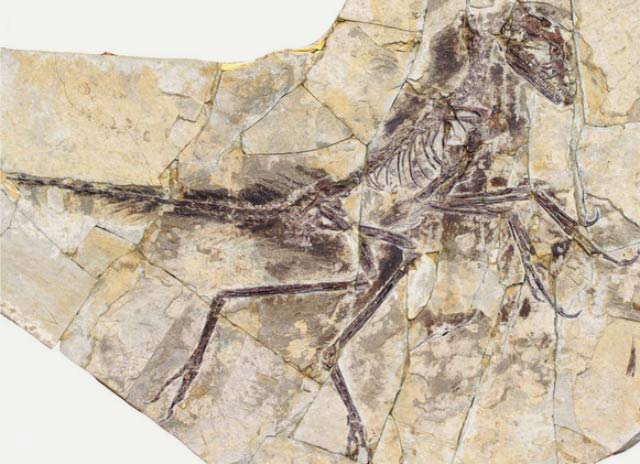
Yep. Another link in the evolutionary chain from birds to dinosaurs has officially been found. It will be a nice and exotic addition to the other transitional fossils discovered in this lineage.
In your face, creationists.
Harun Yahya: Turkish Buffoon
Click here to see a video of Richard Dawkins giving a talk on Muslim Creationist Harun Yahya (Be warned: It is nearly 40 minutes!).
News I found over the weekend
The first deals with some new findings in a very old experiment: The Miller-Urey set up. Apparently, Stanley Miller tried a second version of his experiment in which he injected steam into the sparks he sent into the apparatus (to simulate lagoons and tidal pools around volcanoes). A former student of Miller's, Jeffrey Bada, examined some very ancient vials left over from this experiment and was surprised to find that 22 amino acids were present (More than any other Miller-type experiment has produced!
The article also states that:
Although scientists no longer think that the early atmosphere resembled the gases Dr. Miller used, the gases released by volcanic eruptions do have similar properties. The scientists hypothesize that the sparks split apart water molecules in the steam, enabling a wider range of chemical reactions to take place.
Eat your heart out, Jonathan Wells. On a side note, some of you may remember that only a few months ago Discover published an article on another fascinating origin of life experiment conducted by Dr. Miller.
One more thing in the news: Blogger Halfway There has caught the ICR in a very embarrassing error. Read it here.
Based on a design by N.Design Studio | Blog and Web