Showing posts with label Noah's Ark. Show all posts

Thursday, December 27, 2012

Bad taxonomy

Bad taxonomy: by Donald Prothero via Skepticblog
One of the strangest aspects of “creation science” is their attempt to reconcile the fact that there are between 5-15 million species on earth, yet somehow they all had to fit on Noah’s ark (one pair or seven pairs of them, depending upon which version of the story you read). Such an idea might have made sense to the ancient Hebrews, who only knew of a few dozen kinds of larger mammals in the ancient Middle East, and did not make distinctions between most types of insects or other invertebrates (just as most people today call almost all insects, arachnids, and other small land arthropods “bugs”), let alone recognize the existence of microorganisms. But the modern-day “creation scientist” must be a strict literalist, and cannot take these ancient stories in the context of their times. Instead, these myths must be literally true in today’s context, and then whatever modern science has revealed in the past few centuries must be re-interpreted or discredited or ignored. It’s one of the most astounding examples of motivated reasoning, reduction of cognitive dissonance, cherry-picking, and confirmation bias one could imagine. In the case of shoehorning all of life into tiny Noah’s ark, they even have invented a name for it (“baraminology”). Quite a few creationists play at this pointless game of sophistry, arguing how many angels could dance on the head of a pin.
Let’s start with the term baramin itself. It was created out of nothing by Seventh-Day Adventist Frank Marsh in 1941 by tacking two words together from a Hebrew glossary (bara ”created”; min,  ”kind”) without any idea how Hebrew actually works. Since almost none of the creationists read the Old Testament in the original Hebrew (or they would spot the problems and inconsistencies that make literal interpretation absurd), they don’t realize how ridiculous this term is, and why it doesn’t mean what they think it means. As I learned when I studied Hebrew, the Semitic root “B-R-A” (vowel points were not invented until centuries later) is translated “he created” or “he conjured,” so it is a past-tense verb, not a past participle of a verb, as Marsh used it. And min can be used to mean not only a “kind” but also a species, or even a sex. Slapped together as Marsh did it, the object min replaces the original subject Elohim (one of the names for the gods), so literally translated, baramin means “the species created”, not “god created”—and certainly not “created kinds” in any sense the scriptures use. If Marsh had known any Hebrew and wanted to create a grammatically correct translation of “created kind”, it would have been min baru (past participle). But given the consistently sloppy scholarship of creationists, I would never expect them to get this part right.
Leaving aside their ignorance of Hebrew, the whole topic of “baraminology” reminds one of a laughably poor imitation of science—science as imagined by kids at play, or amateurs who are parroting the forms without understanding any of the principles or protocols or implications of the actual research, or the silly imitation of science in the movies and TV where they spout sciency-sounding words that make no sense whatsoever. The focus of their “research” is to skim over the entire field of modern animal classification and then imagine ways to shoehorn hundreds of individual species and genera into the smallest possible number of categories. They don’t bother to work with actual animals, or get their hands dirty with the dissections and anatomical work that established the modern taxonomy of organisms, or spend the years in graduate school to obtain the kind of training necessary to understand and analyze molecular phylogenetic data, or wade into the gigantic literature of modern systematic theory since the days of Simpson and Mayr and cladistics. No, that would require that they be trained in actual science, and confront the evidence for evolution that runs throughout life. Instead, they do superficial, high-school level “book-report” types of analyses, where they cherry-pick ideas here and there from highly simplified internet sources and Wikipedia articles. They know just enough science to pick up a stray factoid here and there without any understanding of the caveats and methods behind the data, or the relative significance or importance of one kind of data versus another that only comes with years of graduate study in a field.
So what are the methods of “baraminology”? In a nutshell, they are wildly inconsistent. A baramin might correspond to what a real biologist recognizes as a species, a genus, an order, a family, or even an entire phylum (Siegler, 1978; Ward, 1965)! In some cases, they mimic the methods of phenetic taxonomy and look for overall similarity; in others, they ape the terminology of cladistics with such odd terms as “holobaramin”, which has no rigorously-defined meaning whatsoever (since it is based on a concept with no consistent basis or meaning). Unlike real systematists, “baraminologists” don’t work with actual specimens or enumerate real anatomical characters, or analyze their own molecular sequences, or use rigorous methods of character analysis and computerized methods of determining parsimonious solutions. Instead, if this recent effort by veterinarian and “independent scholar” Jean K. Lightner (NOT a systematic biologist) is any indication, it consists largely of looking at images of the animals on the web and deciding by a glance at single photograph which ones rate their own baramin and which ones don’t. Indeed, one “baraminologist” said so in no uncertain terms: “The cognita are not based on explicit or implicit comparisons of characters or biometric distance measures but on the gestalt of the plants and the classification response it elicits in humans.” They remind one of what Humpty Dumpty told Alice (in Through the Looking Glass), “Whenever I use a word, it means just what I choose it to mean.”
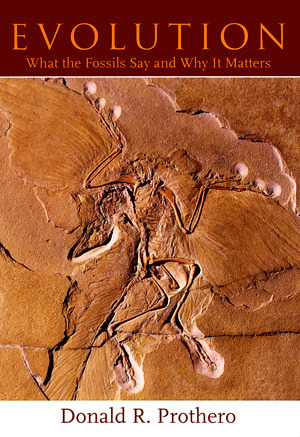
Lightner’s article is particularly revealing. She is trying the reduce the thousands of species of mammals alive today into the smallest number that can fit on Noah’s ark, and ends up with 137 baramin: some are families, some are genera, some are species and others are whole orders within the class Mammalia. She clusters all pigs and peccaries and hippos in one baramin, but splits up the many families of possums and other Australian marsupials into separate baramin. All cats, from tiny ocelots to giant tigers, are one baramin; so too are all canids, from tiny foxes to big wolves. She occasionally quotes parts of recent molecular studies (particularly in the case of hybridization) to lump or separate baramin, but completely ignores the overwhelming evidence from those same molecular studies of the interrelatedness of the taxa involved. In a nutshell, she cherry-picks what makes animals look different today, and avoids anything that might suggest they are closely related to each other. This is like looking at the terminal branches of a tree and trying to find their distinctiveness today, but failing to notice the fact that they are connected the further down you go, and they all come from a common trunk. Her article explicitly avoids talking about ANY fossil evidence (except in the case of horses, which even creationists cannot ignore). But it is precisely that evidence that confirms what anatomical and molecular data have long demonstrated: everything converges to common ancestor if you go back far enough. As I demonstrated in my book Evolution: What the Fossils Say and Why it Matters, you can trace many such terminal branches of the tree of life down to common ancestors that cannot be distinguished. For example (pp. 304-306), those same horses that creationists are so happy to lump into one “kind” can be traced back to primitive dog-sized four- and three-toed ancestors which are nearly identical to the earliest rhinos and earliest tapirs. These are separate baramin according to Lightner, but if she bothered to look closely at these Eocene fossils, she could not tell which baramin they belonged to. In my book, I provide many other examples of lineages which can be traced down to ancestors that are nearly indistinguishable, such as whales and their anthracothere ancestors, the different lineages of antelopes and giraffes and pronghorns, the elephants and the manatees, the pinnipeds (seals, sea lions, and walruses) and their bear-like relatives, and so on. Clearly, if you ignore 99% of the evidence and cherry-pick the most recent members of diverging lineages, you will not see the evidence of evolution in every part of their biology, anatomy, fossil record, and molecular sequences.
Even more startling is the fact that creationists will shoehorn ALL of horse evolution into one baramin! If a creationist saw an early Eocene horse like Protorohippus(formerly “eohippus”) without knowing its connection to modern horses, they would NEVER consider it to be related to a horse. This is virtually all of evolution right there, a concession that evolution on even the largest scale is real. Their only difference with real scientists is that horses are separate from tapirs and rhinos as different kinds, yet the fossil evidence demonstrates even that “macroevolutionary” transition that they refuse to admit.

A plushie version of a pseudocheirid possum from Australia, originally displayed on a website selling plushies but mistaken for the real animal by creationists and posted as such in their article about “baramin”
Perhaps the most revealing aspect of this whole exercise in amateurish incompetence concerned one of the many photographs of animals that Lightner’s web paper stole (without permission or attribution) from various web sources. One of her “animal photos” of a pseudocheirid (“ring-tailed possum”) was not a real animal at all, but a photo of a plush toy! That photo has since been replaced in the original website, but the point is clear: they can’t even tell real animals from toy plushies, since their total level of analysis is to glance at photos on the web, not to work with actual specimens. RationalWiki and P.Z. Myers in his Pharyngula blog noticed this, and pointed out that with a bunch of plush toys on the ark instead of real animals, they might have a lot fewer problems with feeding them or dealing with all the poop. It reminds one of Turkish creationist Harun Yahya and his habit getting fooled by photographs of fishing lures instead of real insects in his ridiculous book Atlas of Creation, that was sent out a few years ago. And it reinforces the conclusion that creationists are completely out of their depth on topics like this, dabbling in stuff stolen from the web like a high-schooler cribbing a report without understanding what they are doing, or even noticing that their pictures don’t show what they think they show!

References

  • Siegler, H.R. 1978. A creationist’s taxonomy. Creation Research Society Quarterly 15:36–38.
  • Ward, R.R. 1965. In the Beginning. Grand Rapids, MI: Baker Book House.

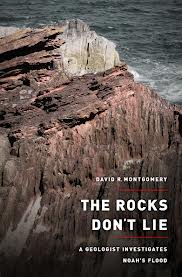
The Rocks don’t lie


A review of The Rocks Don’t Lie: A Geologist Investigates Noah’s Flood, by David R. Montgomery
Creationists are notorious for distorting or denying the facts of biology (evolution), paleontology (denying the evidence of evolution in fossils), physics and astronomy (denying modern cosmology), and many other fields. But some of their most egregious attempts to twist reality to fit their bizarre views are found in “flood geology,” a concoction of strange ideas about the geologic record that clearly demonstrate how little actual experience any of them has in looking at real rocks. I dissected this issue in great detail in Chapter 3 of my 2007 book, Evolution: What the Fossils Say and Why it Matters (Columbia University Press, New York).
David Montgomery, however, devotes an entire book to the topic of geology and creationism. The title is tantalizing, making one wonder whether this is yet another creationist book disguised as real science. But the content is relatively straightforward. Montgomery is a well-respected geomorphologist at the University of Washington who has studied landforms around the world, and he makes it clear up front that he is not about to support the ridiculous ideas of flood geology. Instead, he embarks on a long narration that is part travelogue, part history, and part description of the breakthroughs in biblical scholarship that long ago led to the rejection of biblical literalism by anyone who can actually read the Bible in the original Greek and Hebrew.
His first chapter looks at a number of places on earth where he has done research on Ice Age glacial dams and floods, and shows that they show no evidence of being part of a global flood. In Chapter 2, he recounts the evidence of Grand Canyon with the creationist’s Grand Canyon: A Different View in his hands as he hikes, and remarks (p. 16) simply that “the story was nothing like the tale I read in the rocks I had spent the day hiking past.” Unfortunately, he does not provide enough detail (or illustrations of key outcrops) to really debunk the interpretations of “flood geologists”.
The next two chapters then recount the early history of geology, from the Greeks and Romans, to the Middle Ages when scholars and natural historians tried to shoehorn all of earth history into the narrow accounts of Genesis, and finally were forced to reject the idea of Noah’s Flood by about 1840—all without losing their Christian faith. At the end he remarks (p. 91), “After Cuvier, the drive to find evidence of Noah’s Flood in the rocks was well and truly dead, although modern creationists would later resurrect the idea.” The next chapter then carries the historical narrative through the birth of modern geology, with Hutton, Buckland, and Lyell, and the eventual realization that the earth is immensely old with (in Hutton’s words) “no vestige of a beginning.”
Chapter 8 then jumps to another topic altogether: the discovery by George Smith and the others of ancient Sumerian and Babylonian flood myths that were directly plagiarized by the authors of Genesis. In Chapter 9, Montgomery looks at flood myths in cultures all over the world, and shows that there is no evidence they are describing a single universal flood of Noah. Chapter 10 then goes through the history of modern American creationism, from the Kentucky “Creation Museum” to the birth of fundamentalism, to George Macready Price and his amateurish efforts to create a new “flood geology” in the 1920s through the 1950s. Throughout this account, Montgomery points out how far from reality Price’s imaginary geology was, and how it was fought by genuine Christian geologists like J. Laurence Kulp, who attempted to reconcile Genesis and geology without violating the laws of earth science. Kulp’s efforts were eventually overshadowed by the later backlash into extreme fundamentalism, and marked the end of any attempt at scientific rationality trumping literalism in the creationist community.
Chapter 12 shifts to the story of J Harlen Bretz and the “Scablands floods,” and how this and other Ice Age glacial-dam floods bear no resemblance to Noah’s Flood (despite creationist attempts to hijack this discovery to their advantage). Then in Chapter 13, Montgomery describes the modern incarnation of “flood geology” proposed by Whitcomb and Morris in the 1960s, and this marked the birth of the current creationist attempts to push “flood geology” on the faithful. Throughout the chapter, Montgomery points out the absurdities of the Whitcomb-Morris model. In his final chapter, Montgomery talks about the conflict between science and faith, and tries to be conciliatory to both sides, as long as religion doesn’t try to deny science with absurdly literalistic interpretations of the Bible. In the final pages (pp. 256-257), he adopts a lofty tone:
“The scientific story of the origin and evolution of life, the vast sweep of geologic time, and the complexity of the processes that shaped the world we know today inspire more awe and wonder than the series of one-off miracles from Genesis that I read about in Sunday School. Miracles do not fuel curiosity or innovation. If we embrace the claim that Earth is a few thousand years old, we must also throw out the most basic findings of geology, physics, chemistry or biology. The concept of geologic time, on the other hand, opens up an entirely new creation story, along with the idea that the world is unfinished and creation is ongoing. And a complex, evolving world is one we would be well advised to do our best to understand. Personally, I find a world that invites exploration and learning more inspiring than a world where all is known….Yet no honest search for truth can deny geological discoveries—not when the Earth’s marvelous story is laid out for all to see in the very fabric of our world. We may argue endlessly about how to interpret the Bible, but the rocks don’t lie. They tell it like it was.”
In summary, Montgomery has covered nearly all the bases relevant to creationism, Noah’s ark myths, and “flood geology.” His tone is deliberately relaxed and non-confrontational, and he makes a great effort to educate the reader (both geologist and creationist) about the historical background to these ideas, and why Christian geologists in the 1830s and 1840s rejected Noah’s flood as soon as the rock record became well enough known. He is clearly trying to win the reader who is religious but conflicted about creationism and “flood geology” without saying anything that might alienate either side. My own preference, as I showed in my 2007 evolution book, is to be a bit more pointed and direct, and call a spade a spade when creationists are distorting the truth. I prefer to be explicit in the details of why “flood geology” is wrong, and not to gloss over such evidence (since the creationists themselves seem to relish this sort of nitpicking). I’m not sure which approach works better. Judging from the reviews of Montgomery’s book on its Amazon.com site, most readers seemed to like the gentle tone, although many reviewers would have preferred a stronger attack on creationist absurdities. The one creationist review on Amazon.com shows the usual complete lack of comprehension of the book (if he read any of it at all). If Montgomery attempted to really reach them, his non-confrontational, history-heavy approach did not succeed. However, it cannot hurt to have books with more than one approach to tackling “flood geology” and creationism available on the market. I recommend this book to anyone who wants to read about the background to the debate and the general nature of the evidence, and doesn’t require the point-by-point refutation of creationism that other sources (such as my 2007 book, or the www.talkorigins.org website, provide). Either way, science wins with such books in the hands of readers wavering on the fence between science and superstition.

Wednesday, December 5, 2012

The Top 10 Claims Made by Creationists to Counter Scientific Theories by George Dvorsky

The Top 10 Claims Made by Creationists to Counter Scientific Theories:

One of the most challenging tasks for the modern day creationist to is reconcile the belief in a 6,000 year old Earth with the ever-growing mountain of scientific evidence pointing to a vastly different conclusion — namely a universe that's 13.5 billion years old and an Earth that formed 4.5 billion years ago. So, given these astoundingly dramatic discrepancies, biblical literalists and 'young Earth creationists' have had no choice but to get pretty darned imaginative when brushing science aside. Here are 10 arguments creationists have made to counter scientific theories.

Go To Article

'via Blog this'

Friday, November 23, 2012

A Flood of Nonsense! The Myth of a Universal flood via eSkeptic

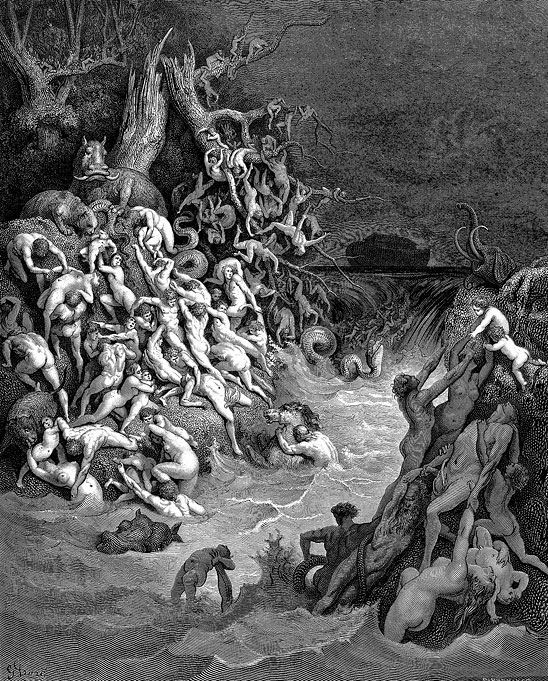
The World Destroyed by Water (illustrated
by Gustave Dore). Dore Bible illustrations can be found at http://www.creationism.org/images/

“And the waters prevailed upon the earth an hundred and fifty days.” —Genesis 7:24 
“The World Destroyed by Water” by Gustave DorĂ©.


A Flood of Nonsense!
The Myth of a Universal flood Myth

by Tim Callahan

One of the programs of the (so-called) History Channel that is particularly galling to me as a skeptic is their Ancient Aliens series, where Erich von Daniken, Zecharia Sitchen, Georgio Tsoukalos and David Childress, among others, advance the pseudo-scientific theory that extraterrestrials both created us through biological engineering and gave us our ancient civilizations. In the process of advancing their dogma, they spout blatant falsehoods that go utterly unchallenged. The History Channel, shamefully, makes no attempt whatsoever to offer any rebuttal to these spurious claims. Rather, as is their policy with any program dealing with the historicity of anything from the Bible, their policy toward ancient astronaut theorists is one of shameless pandering, a strategy most probably determined by favoring profits over proof and ratings over reason. Fortunately, filmmaker Chris White has addressed this imbalance, putting the lie to these claims thoroughly in his three-hour documentary Ancient Aliens Debunked,recently posted on Skeptic.com.
Unfortunately, in one area in particular Mr. White has stumbled badly in his assertion that the biblical story of the flood is not derived from Sumerian flood stories (whose connection to the ancient alien series is thin in any case) and instead claims that both biblical and Sumerian flood stories reflect an actual worldwide flood and are not the result of cultural diffusion from some earlier myth. According to White, all over the world there is a universal myth of a worldwide flood in which only a few people, usually about eight, are saved by entering a boat, while the rest of humanity is drowned. White argues that, of course, one great drawback to such an assertion is that science in no way supports such a universal flood. Geology and the fossil record and genetics all militate strongly against any historical validity of a worldwide flood. Thus, comparative mythology is his only evidence on the offing.
Are flood myths universal? No. At least, not one in which a worldwide flood wipes out all of the human race but for a couple or a single family. Consider the case of China. Does this large country with an unbroken history going back to ancient times have a flood myth, replete with a boat on which a few survivors escape, from thence to reestablish the human race? It does, however that particular flood myth comes from an ethnic minority called the Miao. They speak a language similar to Thai and appear to have immigrated to China from Southeast Asia. The only other flood myth from China involves annual flooding from rivers and the need for people to work together to prevent such destruction. It involves no ark and no destruction of all life on the planet.
Consider also an Egyptian flood myth. Surely this one should be similar to those of the Bible and Mesopotamia if the flood were, in fact, historical. In this myth the gods, suspecting mortal treachery against them, dispatch the goddess Hat-hor to take vengeance on the human race. However, her blood lust gets out of hand and threatens to utterly annihilate humanity. Since this is not the aim of the gods, they pour out upon Egypt a flood of beer brewed from mandrake root, which has soporific properties. Hat-hor, setting out on her daily rampage, looks down at the flooded land of Egypt, sees her own beautiful visage reflected in the beer and bends down to kiss it. She begins to drink the mandrake root beer and drinks so much of it that she forgets the plan of destruction and instead staggers off to bed. Thus, in the Egyptian flood story, the flood saves the human race.
Yet another flood story that differs significantly from the biblical one is found in Norse myth. Odin and his two brothers, Villi and Ve, kill the frost giant, Ymir, and make the world out of his body. His blood creates a flood that drowns most of the other frost giants. All this happens before the creation of the human race.
There is no native Celtic flood myth. I have to stress the word “native” since the Celtic myths, like those of the Teutonic peoples were written down by Christian monks, who harmonized them with myths from the Bible. Here is yet another problem with the vaunted universality of flood myths: Many of them appear courtesy of cultural contamination by Christian and, in some cases, Muslim, missionaries.
Diffusion of flood myths is also a factor. While there are differences between earlier Mesopotamian myths and the story of Noah’s ark, and while there is not a literary descent from the earlier material to the later, there is a cultural continuity. Thus, the Akkadian flood epic, Atrahasis, gave rise to later flood tales, not only the story of Noah in the Bible, but, as well, that of Deucalion and Pyrrha in Greek mythology. We do not find, nor would we expect to find, any great literary correspondence between an Akkadian epic, written on preserved tablets dating from ca. 1650 BCE and the biblical flood myth, the earliest version of which probably dates from ca. 850 BCE.
In his defense of the biblical flood story as history, White also falls back on an old canard, to whit, that the scribal transcription of the biblical text is so precise that it is far more accurate and less open to corrupting changes than any other ancient document. Certainly this might have been true of their transcription once the documents in question were seen as holy writ. However, varying versions of biblical tales were still being written perhaps as late as the Babylonian Captivity (587–538 BCE). That the biblical text is of late compilation is further attested to by its many anachronisms. Consider, as an example, what Genesis says of the place of origin of Abrahm, that is, Abraham (Gen. 11:31 emphasis added):
Tereh took Abrahm his son and Lot, the son of Haran, his grandson and Sarai his daughter-in-law, his son Abrahm’s wife, and he went forth from Ur of the Chaldeans to go into the land of Canaan; but when they came to Haran they settled there.
While this test purports to be from the hand of Moses, written sometime between 1400 and 1200 BCE, the Chaldeans did not occupy Ur until ca. 800 BCE. Hence, this document’s reference to Ur as “Ur of the Chaldeans” dates it as having been written after that time.
Chris White would do a great service to the cause of critical thinking, and to himself as well, were he to excise the flood material from his otherwise exemplary documentary. END


Wednesday, December 28, 2011

What Scientists Do and Creationists Don't

By Skip @ Panda's Thumb

What Scientists Do and Creationists Don't:
A favorite creationist mantra these days, and one you especially hear from young earthers, is that creationists and scientists both have the same facts, they just look at them differently. To laypeople that may sound reasonable. The handful of guys at Answers in Genesis look at the Grand Canyon and say it was formed by a flood about 4400 years ago when God got all pissed off at humans. The 24,000 members of the Geological Society of America (and virtually every member of the literally dozens of geological organizations listed at their web site*) look at the Grand Canyon and say it was formed over millions of years by natural processes that continue today.

Same facts; different conclusions. Some of us laypeople often hear these two positions and see them as equally valid positions on either side of a debate. But some of us scratch the surface, and it doesn’t take a very deep scratch to see a significant difference. Scientists do science and creationists don’t.

I’m currently making my way through the December 2010 Evolution: Education & Outreach, a special issue dealing with the teaching of phylogenetics. On page 507 in an article titled “How to Read a Phylogenetic Tree,” by Deborah A. McLennan, I came across the following. “…butterflies can be distinguished from cats and people because they have an exoskeleton made out of chitin (a tough, waterproof derivative of glucose).” This was one of those “how do they know that” moments for me. Having read Genetics for Dummies and other books in my efforts to start getting a handle on genetics, I’m really getting into how genetic relationships reveal evolutionary history. Could this be another one of those cases?

But first I wanted to at least know what chitin is. Wikipedia says it “is the main component of the cell walls of fungi, the exoskeletons of arthropods such as crustaceans.” Interesting enough. It also says in terms of function it’s comparable to the protein keratin, and that it has several useful medical and industrial applications. Neat-o! But what about evolution? Does evolution have anything to say about where this stuff came from?

Plugging “evolution of chitin” in Google returns a bunch of links, and the very first one I clicked on said, “[a]nalysis of a group of invertebrate proteins, including chitinases and peritrophic matrix proteins, reveals the presence of chitin-binding domains that share significant amino acid sequence similarity. The data suggest that these domains evolved from a common ancestor which may be a protein containing a single chitin-binding domain.” So it looks like these researchers have a pretty good idea about chitin’s history, and where it came from.

But the abstract also says that “comparisons indicated that invertebrate and plant chitin binding domains do not share significant amino acid sequence similarity, suggesting that they are not coancestral…We propose that the invertebrate and the plant chitin-binding domains share similar mechanisms for folding and saccharide binding and that they evolved by convergent evolution.”

So this research concludes that chitin in invertebrates evolved from a common ancestor, but invertebrate and plant chitin evolved independently.

Want to know more? how about a possible history of the stuff in humans traced all the way back “to the time of the bilaterian expansion (approx. 550 mya).” Furthermore, this paper documents some real twists and turns in chitin’s history: “The family expanded in the chitinous protostomes C. elegans and D. melanogaster, declined in early deuterostomes as chitin synthesis disappeared, and expanded again in late deuterostomes with a significant increase in gene number after the avian/mammalian split.” Someone has clearly done their homework!

This little exercise took me about 15 minutes, and I learned a little bit about chitin: what it is and got a glimpse into where it came from and how scientists are learning its history. Scientists doing science.

What do creationists say about chitin? I plugged the term in the search engine at Answers in Genesis and found an article called “What a Body!” by Professor Wolfgang Kuhn, who describes chitin as a “wonder substance” composed of protein and sugar. He further describes it as a “miracle body” and says that “even if we could produce chitin itself, all our modern technology would be unable to imitate this fine microstructure so as to make a sports car body out of it, for instance.”

What is the takeaway message of Kuhn’s article? “Next time you see this humble beetle, consider the incredible amount of programmed information needed just to construct this super-high-tech marvel, its outer coat. Such information is passed on generation after generation, silent testimony to the Master Programmer.”

Creationism is so easy! When the earth is only a few thousand years old, and plants, animals, everything on earth has no real history or past different from the present, it’s enough to call things “wonder substance” and “miracle body”. Poof! God did it… class dismissed.

I’ve often read creationists complain about the amounts of funding real scientists receive and how much is distributed by the NIH and the NSF. If only creationists had this kind of funding, they could do amazing research! But would they?

Answers in Genesis, perhaps the most visible and well-funded anti-evolution organization in the country, spent approximately $27 million building its creation “museum” in Kentucky. AiG is presently raising money for their latest venture, a Noah’s Ark theme park, estimated to cost $24.5 million when completed. I have a suggestion for Ken Ham and the folks at AiG. Why not spend a fraction of that 24 and a half million to actually do a scientific experiment? For instance: build a real ark, fill it with animals just like Noah is claimed to have done and float it out in the ocean for a year to test the hypothesis. Think of all the converts that would win when it worked! Hell, I’d get saved myself!

I emailed Dr. John Hawks at the University of Wisconsin, Madison, and asked him about funding scientific research and he replied, “Last year NIH spent $8 million on the Cancer Genome Atlas, bringing it to a total of $43 million. This project works on the principle that cancer cells are engaged in an evolutionary process in the body that will often be convergent in different people, so that building a systematic atlas of the genes involved will help us understand and find effective strategies to treat different cancers.”

So for less than the cost of two huge, embarrassing testaments to ignorance and misinformation AiG could have funded something like the entire Cancer Genome Atlas. But then again, at the creation “museum” they have a Triceratops with a saddle!

It’s clear that for a fraction of what the creationist organizations spend on propaganda, they could easily fund lab work and research to publish evidence of their claims. But what they do publish is nothing more than distortions of real research. PZ Myers exposes a typical example about, coincidentally, chitin.

Even some lower-tier creationists pull down some pretty serious dough. Eric Hovind, son of federal prison inmate and notorious huckster Kent Hovind, is raising $1.5 million to make a film about the book of Genesis. In the 2011 Winter issue of his publication Creation Today, Son of Hovind claims he’s raised over $255,000.

Well, Eric Hovind has a high tech studio he makes his videos in, and I bet he has a few computers around there. What more does he need? Reed Cartwright, Biodesign Institute at Arizona State University, tells me, “For a lot of computational genomics research, the data is already available and the only costs are for computers and salaries. And purchasing time on supercomputers is currently cheap.” So here’s another suggestion: Why doesn’t Hovind fund a couple of creationist geneticists to do some research when his computers are otherwise unoccupied? I’m sure he’d discover that every species on earth went through a genetic bottleneck about 4400 years ago that reduced the entire population to just two individuals … on a boat. Right, Eric?

Opportunities abound for creationists to fund real scientific research. Nick Matzke sent me this link. Use the Award Search feature and spend a few minutes checking out all the great research done on much smaller budgets than a theme park, or feature length film production.

Maybe scientists and creationists have the same facts. But if they do, it’s because one of those groups actually cared enough about truth to find out what the facts were. It’s not the creationists. Only one of those groups selfishly obsesses over their personal beliefs to the point of ignoring and distorting legitimate scientific research to further a social and theological agenda. And it’s not the scientists.
Note: As has been pointed out to me, what I have discovered in these papers is research on the evolution of chitin-binding proteins, not chitin itself. This layperson has learned that chitin is made from and digested by proteins that do evolve, and that’s what the research I found was all about. 
* I say ‘virtually’ because with the tens, or hundreds, of thousands of members across all those organizations there are probably a couple of young-earthers. But I’ll bet you can’t find one geologist, anywhere, who thinks the earth is six thousand years old who doesn’t regard the Bible (or whatever their favorite holy text is) as without error.
(Finally, this piece is cross-posted to my brand new blog, sciencedenial.com, so come on over to my place and give me some of your Internet love, you bunch of bad low motor scooters.)


Sunday, January 30, 2011

No one ever found Noah's Ark

The hard-core fundamentalists love forwarding links to sites like this one, alleging to provide archeological proof of various fantasies from The Bible -- such as Noah's Ark.

Here is a good resource for understanding the bunk behind these alleged findings.