Showing posts with label Fossils. Show all posts

Thursday, June 27, 2013

700,000-Year-Old Horse Becomes Oldest Creature With Sequenced Genome - ScienceNOW

700,000-Year-Old Horse Becomes Oldest Creature With Sequenced Genome

on 26 June 2013, 2:45 PM 

Scientists have sequenced the oldest genome to date—and shaken up the horse family tree in the process. Ancient DNA derived from a horse fossil that's between 560,000 and 780,000 years old suggests that all living equids—members of the family that includes horses, donkeys, and zebras—shared a common ancestor that lived at least 4 million years ago, approximately 2 million years earlier than most previous estimates. The discovery offers new insights into equine evolution and raises the prospect of recovering and exploring older DNA than previously thought possible.
Go To Article

Tuesday, June 25, 2013

A Transitional Turtle | Eye on the ICR

A Transitional Turtle

25JUN
Horniman turtle carapace skeletonTurtles: how did they evolve?
Turtles (a group which includes within it tortoises) are most famous for their shells, which are made of their fused ribs. No other animal has a shell constructed in this manner, and it is a feature that all turtles share. The turtle evolution question, therefore, is somewhat synonymous with how turtle shells evolved. It’s also a case where creationists might reasonably ask “where are the transitional forms” – how do you get to shell from no shell? Unfortunately for them, fossils that fit the bill do exist. In 2009, for example, fossils of Odontochelys were discovered in China. This turtle had a complete plastron, the bottom of the shell, but instead of the upper part (the carapace) it merely had broadened rib bones. That sounds like a transitional form to me.
Go To Article

Saturday, March 9, 2013

Providing evidence for evolution | Skeptoid

Providing evidence for evolution

Last week I pointed out some common misconceptions about evolution and arguments that  are often used to support creationism. This week I would like to share some of what I feel to be the strongest evidences for evolution. I feel like too often in debates about evolution the focus seems to be on refuting creationism instead of correctly presenting evolution – and the science is really awesome. With the evidence I present here I seek to answer the following questions:
What is the fossil evidence for evolution?
What can we learn about evolution from living animals?
Does evolution present any testable predictions?
What is the fossil evidence for evolution?
One of the common arguments against evolution is “where are the transition fossils”. This is perhaps the weakest of all arguments against evolution. The transition fossils (or casts of the fossils) are available in every reliable natural history museum. Wikipedia has an extensive list of transition fossils. These fossils include the human evolution of Australopithecus to Homo Habilis to Homo Erectus to Homo Sapien. They include evolution of invertebrates to fish. They even include the evolution of insects.
The fossil evidence is extensive, and the argument that we don’t have fossil evidence is tired. Creationists quickly say things like “just show me the transition fossils” or “where is the missing link”, but we actually have quite a bit of fossil evidence. Just this last week Dr. Steven Novella wrote a great article on feathered dinosaurs – an excellent example of transition fossils.
Unfortunately, each time new evidence of this type is presented creationists treat the new fossil like the hydra from greek mythology – finding one transition fossil just creates two new transitions whose fossils haven’t been found yet.
Go To Article

NeuroLogica Blog » Transition Denial and Feathered Dinosaurs

Transition Denial and Feathered Dinosaurs

Published by under Creationism/ID

There are a few areas of evolutionary biology that particularly fascinate me, partly because they represent such a dramatic example of large-scale (macro) evolutionary change. The evolution of whales from terrestrial mammals and of humans from ape ancestors are two of my favorites. But perhaps more dramatic still is the evolution of birds from theropod dinosaurs.
Each discovery of a feathered dinosaur or bird ancestor is a lance straight through the heart of creationist denial of evolution. I have to admit it’s fun to watch prominent creationists squirm when confronted with such clear evidence of transitional forms and evolutionary change – not that they flinch in their denial, but their protestations do become increasingly shrill and desperate.
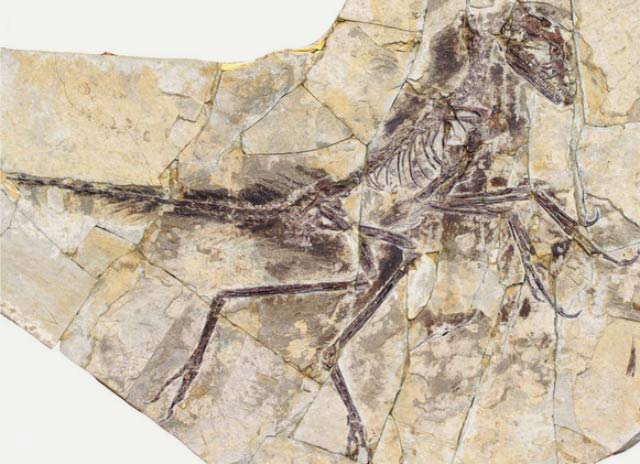
Welcome Eosinopteryx brevipenna, the latest feathered dinosaur discovered in China. This little guy had feathers, although described as “reduced plumage”, stubby wings (and so was probably flightless), a bony tail, teeth, and clawed fingers. It also lacked many modern bird features, such as bony features that would have allowed for full flapping flight. Its feet were clearly adapted for running.
http://theness.com/neurologicablog/wp-content/uploads/2013/02/Eosinopteryx.jpg
Go To Article

Tuesday, February 5, 2013

Only a bird » Pharyngula

Only a bird » Pharyngula:

Another feathered dinosaur has been found in China, prompting Ken Ham to dig in his heels and issue denials.
Yet another supposed “feathered dinosaur” fossil has come to light, again in China. (Dr. Elizabeth Mitchell, AiG–U.S., reported on another Chinese fossil of a supposed feathered dinosaur in April 2012) Now, one headline described the fossil as “almost birdlike,” and the authors of the report in Nature Communications note many features the fossil shares with living birds, particularly those that live on the ground. In fact, Dr. Elizabeth Mitchell and Dr. David Menton (AiG–U.S.) both examined the photos of the fossil and the criteria the authors used in classifying the fossil as a dinosaur. They agreed that it is a bird, not a feathered dinosaur.
Oh, really? It’s just a bird? Take a look at this image of Eosinopteryx, and you tell me.
eosinopteryx2
Notice a few things about this animal: it’s got teeth. The forelimbs have clawed digits. It has a long bony tail. It lacks the bony keel that anchors breast muscles in modern birds.
The only thing that might cause you to question its dinosaur nature (and it’s a criterion that’s proving more and more inappropriate) is that lovely gray fringe of feather impressions that surround the whole fossil. And look at those forelimbs! It looks like it has stubby wings. It does not, however, have the skeletal and muscular structure to allow for extended flapping flight, and the wings are way too short for it to have been an adequate flyer.
But Mitchell and Menton and Ham looked at that and said ‘ALL BIRD’. They’re idiots.
Ham goes on: there are no transitional forms, he squeaks, there can be no transitional forms, transitional forms don’t exist…all while looking at a winged, feathered reptile with teeth and claws and a bony tail.
The fossil record doesn’t reveal any kind of dinosaur-to-bird evolution—and it certainly does not show a molecules-to-man evolution. We have no proof of transitional forms, and we won’t. God’s Word says clearly that He created animals and plants according to their kinds (Genesis 1). Through genetic loss and other factors, new species have emerged over time—but birds are still birds and apes are still apes. Nothing in the history of biology has legitimately shown that dinosaurs could develop the genetic information to evolve into birds.
Pitiful. Pathetic. I’d like to see a creationist sit down in front of me with that illustration and try to defend the claim that it’s only a bird.

Godefroit P, Demuynck H, Dyke G, Hu D, Escuillie F, Claeys P (2013) Reduced plumage and flight ability of a new Jurassic paravian theropod from China. Nature Communications 4, 1394. doi: 10.1038/ncomms2389


'via Blog this'

Thursday, December 27, 2012

Bad taxonomy

Bad taxonomy: by Donald Prothero via Skepticblog
One of the strangest aspects of “creation science” is their attempt to reconcile the fact that there are between 5-15 million species on earth, yet somehow they all had to fit on Noah’s ark (one pair or seven pairs of them, depending upon which version of the story you read). Such an idea might have made sense to the ancient Hebrews, who only knew of a few dozen kinds of larger mammals in the ancient Middle East, and did not make distinctions between most types of insects or other invertebrates (just as most people today call almost all insects, arachnids, and other small land arthropods “bugs”), let alone recognize the existence of microorganisms. But the modern-day “creation scientist” must be a strict literalist, and cannot take these ancient stories in the context of their times. Instead, these myths must be literally true in today’s context, and then whatever modern science has revealed in the past few centuries must be re-interpreted or discredited or ignored. It’s one of the most astounding examples of motivated reasoning, reduction of cognitive dissonance, cherry-picking, and confirmation bias one could imagine. In the case of shoehorning all of life into tiny Noah’s ark, they even have invented a name for it (“baraminology”). Quite a few creationists play at this pointless game of sophistry, arguing how many angels could dance on the head of a pin.
Let’s start with the term baramin itself. It was created out of nothing by Seventh-Day Adventist Frank Marsh in 1941 by tacking two words together from a Hebrew glossary (bara ”created”; min,  ”kind”) without any idea how Hebrew actually works. Since almost none of the creationists read the Old Testament in the original Hebrew (or they would spot the problems and inconsistencies that make literal interpretation absurd), they don’t realize how ridiculous this term is, and why it doesn’t mean what they think it means. As I learned when I studied Hebrew, the Semitic root “B-R-A” (vowel points were not invented until centuries later) is translated “he created” or “he conjured,” so it is a past-tense verb, not a past participle of a verb, as Marsh used it. And min can be used to mean not only a “kind” but also a species, or even a sex. Slapped together as Marsh did it, the object min replaces the original subject Elohim (one of the names for the gods), so literally translated, baramin means “the species created”, not “god created”—and certainly not “created kinds” in any sense the scriptures use. If Marsh had known any Hebrew and wanted to create a grammatically correct translation of “created kind”, it would have been min baru (past participle). But given the consistently sloppy scholarship of creationists, I would never expect them to get this part right.
Leaving aside their ignorance of Hebrew, the whole topic of “baraminology” reminds one of a laughably poor imitation of science—science as imagined by kids at play, or amateurs who are parroting the forms without understanding any of the principles or protocols or implications of the actual research, or the silly imitation of science in the movies and TV where they spout sciency-sounding words that make no sense whatsoever. The focus of their “research” is to skim over the entire field of modern animal classification and then imagine ways to shoehorn hundreds of individual species and genera into the smallest possible number of categories. They don’t bother to work with actual animals, or get their hands dirty with the dissections and anatomical work that established the modern taxonomy of organisms, or spend the years in graduate school to obtain the kind of training necessary to understand and analyze molecular phylogenetic data, or wade into the gigantic literature of modern systematic theory since the days of Simpson and Mayr and cladistics. No, that would require that they be trained in actual science, and confront the evidence for evolution that runs throughout life. Instead, they do superficial, high-school level “book-report” types of analyses, where they cherry-pick ideas here and there from highly simplified internet sources and Wikipedia articles. They know just enough science to pick up a stray factoid here and there without any understanding of the caveats and methods behind the data, or the relative significance or importance of one kind of data versus another that only comes with years of graduate study in a field.
So what are the methods of “baraminology”? In a nutshell, they are wildly inconsistent. A baramin might correspond to what a real biologist recognizes as a species, a genus, an order, a family, or even an entire phylum (Siegler, 1978; Ward, 1965)! In some cases, they mimic the methods of phenetic taxonomy and look for overall similarity; in others, they ape the terminology of cladistics with such odd terms as “holobaramin”, which has no rigorously-defined meaning whatsoever (since it is based on a concept with no consistent basis or meaning). Unlike real systematists, “baraminologists” don’t work with actual specimens or enumerate real anatomical characters, or analyze their own molecular sequences, or use rigorous methods of character analysis and computerized methods of determining parsimonious solutions. Instead, if this recent effort by veterinarian and “independent scholar” Jean K. Lightner (NOT a systematic biologist) is any indication, it consists largely of looking at images of the animals on the web and deciding by a glance at single photograph which ones rate their own baramin and which ones don’t. Indeed, one “baraminologist” said so in no uncertain terms: “The cognita are not based on explicit or implicit comparisons of characters or biometric distance measures but on the gestalt of the plants and the classification response it elicits in humans.” They remind one of what Humpty Dumpty told Alice (in Through the Looking Glass), “Whenever I use a word, it means just what I choose it to mean.”
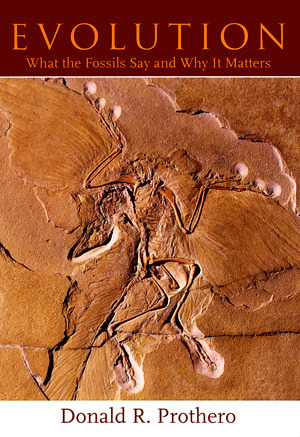
Lightner’s article is particularly revealing. She is trying the reduce the thousands of species of mammals alive today into the smallest number that can fit on Noah’s ark, and ends up with 137 baramin: some are families, some are genera, some are species and others are whole orders within the class Mammalia. She clusters all pigs and peccaries and hippos in one baramin, but splits up the many families of possums and other Australian marsupials into separate baramin. All cats, from tiny ocelots to giant tigers, are one baramin; so too are all canids, from tiny foxes to big wolves. She occasionally quotes parts of recent molecular studies (particularly in the case of hybridization) to lump or separate baramin, but completely ignores the overwhelming evidence from those same molecular studies of the interrelatedness of the taxa involved. In a nutshell, she cherry-picks what makes animals look different today, and avoids anything that might suggest they are closely related to each other. This is like looking at the terminal branches of a tree and trying to find their distinctiveness today, but failing to notice the fact that they are connected the further down you go, and they all come from a common trunk. Her article explicitly avoids talking about ANY fossil evidence (except in the case of horses, which even creationists cannot ignore). But it is precisely that evidence that confirms what anatomical and molecular data have long demonstrated: everything converges to common ancestor if you go back far enough. As I demonstrated in my book Evolution: What the Fossils Say and Why it Matters, you can trace many such terminal branches of the tree of life down to common ancestors that cannot be distinguished. For example (pp. 304-306), those same horses that creationists are so happy to lump into one “kind” can be traced back to primitive dog-sized four- and three-toed ancestors which are nearly identical to the earliest rhinos and earliest tapirs. These are separate baramin according to Lightner, but if she bothered to look closely at these Eocene fossils, she could not tell which baramin they belonged to. In my book, I provide many other examples of lineages which can be traced down to ancestors that are nearly indistinguishable, such as whales and their anthracothere ancestors, the different lineages of antelopes and giraffes and pronghorns, the elephants and the manatees, the pinnipeds (seals, sea lions, and walruses) and their bear-like relatives, and so on. Clearly, if you ignore 99% of the evidence and cherry-pick the most recent members of diverging lineages, you will not see the evidence of evolution in every part of their biology, anatomy, fossil record, and molecular sequences.
Even more startling is the fact that creationists will shoehorn ALL of horse evolution into one baramin! If a creationist saw an early Eocene horse like Protorohippus(formerly “eohippus”) without knowing its connection to modern horses, they would NEVER consider it to be related to a horse. This is virtually all of evolution right there, a concession that evolution on even the largest scale is real. Their only difference with real scientists is that horses are separate from tapirs and rhinos as different kinds, yet the fossil evidence demonstrates even that “macroevolutionary” transition that they refuse to admit.

A plushie version of a pseudocheirid possum from Australia, originally displayed on a website selling plushies but mistaken for the real animal by creationists and posted as such in their article about “baramin”
Perhaps the most revealing aspect of this whole exercise in amateurish incompetence concerned one of the many photographs of animals that Lightner’s web paper stole (without permission or attribution) from various web sources. One of her “animal photos” of a pseudocheirid (“ring-tailed possum”) was not a real animal at all, but a photo of a plush toy! That photo has since been replaced in the original website, but the point is clear: they can’t even tell real animals from toy plushies, since their total level of analysis is to glance at photos on the web, not to work with actual specimens. RationalWiki and P.Z. Myers in his Pharyngula blog noticed this, and pointed out that with a bunch of plush toys on the ark instead of real animals, they might have a lot fewer problems with feeding them or dealing with all the poop. It reminds one of Turkish creationist Harun Yahya and his habit getting fooled by photographs of fishing lures instead of real insects in his ridiculous book Atlas of Creation, that was sent out a few years ago. And it reinforces the conclusion that creationists are completely out of their depth on topics like this, dabbling in stuff stolen from the web like a high-schooler cribbing a report without understanding what they are doing, or even noticing that their pictures don’t show what they think they show!

References

  • Siegler, H.R. 1978. A creationist’s taxonomy. Creation Research Society Quarterly 15:36–38.
  • Ward, R.R. 1965. In the Beginning. Grand Rapids, MI: Baker Book House.

The Rocks don’t lie


A review of The Rocks Don’t Lie: A Geologist Investigates Noah’s Flood, by David R. Montgomery
Creationists are notorious for distorting or denying the facts of biology (evolution), paleontology (denying the evidence of evolution in fossils), physics and astronomy (denying modern cosmology), and many other fields. But some of their most egregious attempts to twist reality to fit their bizarre views are found in “flood geology,” a concoction of strange ideas about the geologic record that clearly demonstrate how little actual experience any of them has in looking at real rocks. I dissected this issue in great detail in Chapter 3 of my 2007 book, Evolution: What the Fossils Say and Why it Matters (Columbia University Press, New York).
David Montgomery, however, devotes an entire book to the topic of geology and creationism. The title is tantalizing, making one wonder whether this is yet another creationist book disguised as real science. But the content is relatively straightforward. Montgomery is a well-respected geomorphologist at the University of Washington who has studied landforms around the world, and he makes it clear up front that he is not about to support the ridiculous ideas of flood geology. Instead, he embarks on a long narration that is part travelogue, part history, and part description of the breakthroughs in biblical scholarship that long ago led to the rejection of biblical literalism by anyone who can actually read the Bible in the original Greek and Hebrew.
His first chapter looks at a number of places on earth where he has done research on Ice Age glacial dams and floods, and shows that they show no evidence of being part of a global flood. In Chapter 2, he recounts the evidence of Grand Canyon with the creationist’s Grand Canyon: A Different View in his hands as he hikes, and remarks (p. 16) simply that “the story was nothing like the tale I read in the rocks I had spent the day hiking past.” Unfortunately, he does not provide enough detail (or illustrations of key outcrops) to really debunk the interpretations of “flood geologists”.
The next two chapters then recount the early history of geology, from the Greeks and Romans, to the Middle Ages when scholars and natural historians tried to shoehorn all of earth history into the narrow accounts of Genesis, and finally were forced to reject the idea of Noah’s Flood by about 1840—all without losing their Christian faith. At the end he remarks (p. 91), “After Cuvier, the drive to find evidence of Noah’s Flood in the rocks was well and truly dead, although modern creationists would later resurrect the idea.” The next chapter then carries the historical narrative through the birth of modern geology, with Hutton, Buckland, and Lyell, and the eventual realization that the earth is immensely old with (in Hutton’s words) “no vestige of a beginning.”
Chapter 8 then jumps to another topic altogether: the discovery by George Smith and the others of ancient Sumerian and Babylonian flood myths that were directly plagiarized by the authors of Genesis. In Chapter 9, Montgomery looks at flood myths in cultures all over the world, and shows that there is no evidence they are describing a single universal flood of Noah. Chapter 10 then goes through the history of modern American creationism, from the Kentucky “Creation Museum” to the birth of fundamentalism, to George Macready Price and his amateurish efforts to create a new “flood geology” in the 1920s through the 1950s. Throughout this account, Montgomery points out how far from reality Price’s imaginary geology was, and how it was fought by genuine Christian geologists like J. Laurence Kulp, who attempted to reconcile Genesis and geology without violating the laws of earth science. Kulp’s efforts were eventually overshadowed by the later backlash into extreme fundamentalism, and marked the end of any attempt at scientific rationality trumping literalism in the creationist community.
Chapter 12 shifts to the story of J Harlen Bretz and the “Scablands floods,” and how this and other Ice Age glacial-dam floods bear no resemblance to Noah’s Flood (despite creationist attempts to hijack this discovery to their advantage). Then in Chapter 13, Montgomery describes the modern incarnation of “flood geology” proposed by Whitcomb and Morris in the 1960s, and this marked the birth of the current creationist attempts to push “flood geology” on the faithful. Throughout the chapter, Montgomery points out the absurdities of the Whitcomb-Morris model. In his final chapter, Montgomery talks about the conflict between science and faith, and tries to be conciliatory to both sides, as long as religion doesn’t try to deny science with absurdly literalistic interpretations of the Bible. In the final pages (pp. 256-257), he adopts a lofty tone:
“The scientific story of the origin and evolution of life, the vast sweep of geologic time, and the complexity of the processes that shaped the world we know today inspire more awe and wonder than the series of one-off miracles from Genesis that I read about in Sunday School. Miracles do not fuel curiosity or innovation. If we embrace the claim that Earth is a few thousand years old, we must also throw out the most basic findings of geology, physics, chemistry or biology. The concept of geologic time, on the other hand, opens up an entirely new creation story, along with the idea that the world is unfinished and creation is ongoing. And a complex, evolving world is one we would be well advised to do our best to understand. Personally, I find a world that invites exploration and learning more inspiring than a world where all is known….Yet no honest search for truth can deny geological discoveries—not when the Earth’s marvelous story is laid out for all to see in the very fabric of our world. We may argue endlessly about how to interpret the Bible, but the rocks don’t lie. They tell it like it was.”
In summary, Montgomery has covered nearly all the bases relevant to creationism, Noah’s ark myths, and “flood geology.” His tone is deliberately relaxed and non-confrontational, and he makes a great effort to educate the reader (both geologist and creationist) about the historical background to these ideas, and why Christian geologists in the 1830s and 1840s rejected Noah’s flood as soon as the rock record became well enough known. He is clearly trying to win the reader who is religious but conflicted about creationism and “flood geology” without saying anything that might alienate either side. My own preference, as I showed in my 2007 evolution book, is to be a bit more pointed and direct, and call a spade a spade when creationists are distorting the truth. I prefer to be explicit in the details of why “flood geology” is wrong, and not to gloss over such evidence (since the creationists themselves seem to relish this sort of nitpicking). I’m not sure which approach works better. Judging from the reviews of Montgomery’s book on its Amazon.com site, most readers seemed to like the gentle tone, although many reviewers would have preferred a stronger attack on creationist absurdities. The one creationist review on Amazon.com shows the usual complete lack of comprehension of the book (if he read any of it at all). If Montgomery attempted to really reach them, his non-confrontational, history-heavy approach did not succeed. However, it cannot hurt to have books with more than one approach to tackling “flood geology” and creationism available on the market. I recommend this book to anyone who wants to read about the background to the debate and the general nature of the evidence, and doesn’t require the point-by-point refutation of creationism that other sources (such as my 2007 book, or the www.talkorigins.org website, provide). Either way, science wins with such books in the hands of readers wavering on the fence between science and superstition.

Wednesday, December 5, 2012

The Top 10 Claims Made by Creationists to Counter Scientific Theories by George Dvorsky

The Top 10 Claims Made by Creationists to Counter Scientific Theories:

One of the most challenging tasks for the modern day creationist to is reconcile the belief in a 6,000 year old Earth with the ever-growing mountain of scientific evidence pointing to a vastly different conclusion — namely a universe that's 13.5 billion years old and an Earth that formed 4.5 billion years ago. So, given these astoundingly dramatic discrepancies, biblical literalists and 'young Earth creationists' have had no choice but to get pretty darned imaginative when brushing science aside. Here are 10 arguments creationists have made to counter scientific theories.

Go To Article

'via Blog this'

Monday, July 9, 2012

What would disprove evolution? « Why Evolution Is True

"If evolution is a scientific theory worth its salt, then there must be some conceivable observations that could show it to be wrong. I just wanted to put down, for the record, what some of those observations might be. First, let’s reprise what I see as the major components of the theory of evolution."
Read On

Wednesday, February 1, 2012

Rethinking "Out of Africa"

By Christopher Stringer

I'm thinking a lot about species concepts as applied to humans, about the "Out of Africa" model, and also looking back into Africa itself. I think the idea that modern humans originated in Africa is still a sound concept. Behaviorally and physically, we began our story there, but I've come around to thinking that it wasn't a simple origin. Twenty years ago, I would have argued that our species evolved in one place, maybe in East Africa or South Africa. There was a period of time in just one place where a small population of humans became modern, physically and behaviourally. Isolated and perhaps stressed by climate change, this drove a rapid and punctuational origin for our species. Now I don’t think it was that simple, either within or outside of Africa.
Go To Article

Wednesday, January 25, 2012

Why Do So Many Have Trouble Believing In Evolution?

Why Do So Many Have Trouble Believing In Evolution?

Sometimes the fossil record comes with teeth: Mapusaurus roseae on display in the "Dinosaurs of Gondwana" exhibit in 2009 at the National Museum of Nature and Science in Tokyo.
EnlargeJunko Kimura/Getty Images
Sometimes the fossil record comes with teeth: Mapusaurus roseae on display in the "Dinosaurs of Gondwana" exhibit in 2009 at the National Museum of Nature and Science in Tokyo.
Updated on Thursday at 1:15 p.m.: After reading your comments, I feel it's important to clarify a couple of points concerning human hereditary descent and horizontal gene transfer. Please see the bracketed additions below.

The evidence is clear, as in a February 2009 Gallup Poll, taken on the eve of the 200th anniversary of Charles Darwin's birthday, that reported only 39 percent of Americans say they "believe in the theory of evolution," while a quarter say they do not believe in the theory, and another 36 percent don't have an opinion either way.
Go To Article

Wednesday, November 30, 2011

A tooth, a myth—and creationist lies. By Donald Prothero

"People love to touch old objects and feel a connection to the past, whether it be the Wailing Wall in Jerusalem, ancient ruins in China or India or Egypt or Europe, pieces of fossil bone on display in a museum, or the oldest objects known, the 4.6 billion-year-old meteorites. Each time I travel to do research in historic old museum collections, it feels a bit like time travel."
Go To Article

Wednesday, September 7, 2011

Skepticblog » Bird Fossils and Clueless Creationists

"About a month ago, there was big publicity about the discovery and description of a new fossil bird from China, Xiaotingia zhengi. It is one of a long line of amazingly preserved bird fossils that have come from Jurassic and Cretaceous beds in Liaoning and other areas in China, and have completely revolutionized our understanding of early bird evolution. "
Go To Article

Friday, February 11, 2011

The Missing Link Fallacy

"its a bacchanalian romp of differing misconceptions and twisted logic - basically, nothing out of the ordinary for a creationist, for whom apparently the addition of even more terrible ideas can only strengthen your argument. Very quickly, I got bored of the tedious process of writing a comment correcting these misconceptions, and I was just about to ignore it and start writing my next article." Read More.

- Sent using Google Toolbar"

Sunday, January 23, 2011

There ARE transitional fossils


Creationists love to pretend there are no "transitional fossils." See for yourself. But they are lying. It's maddening.